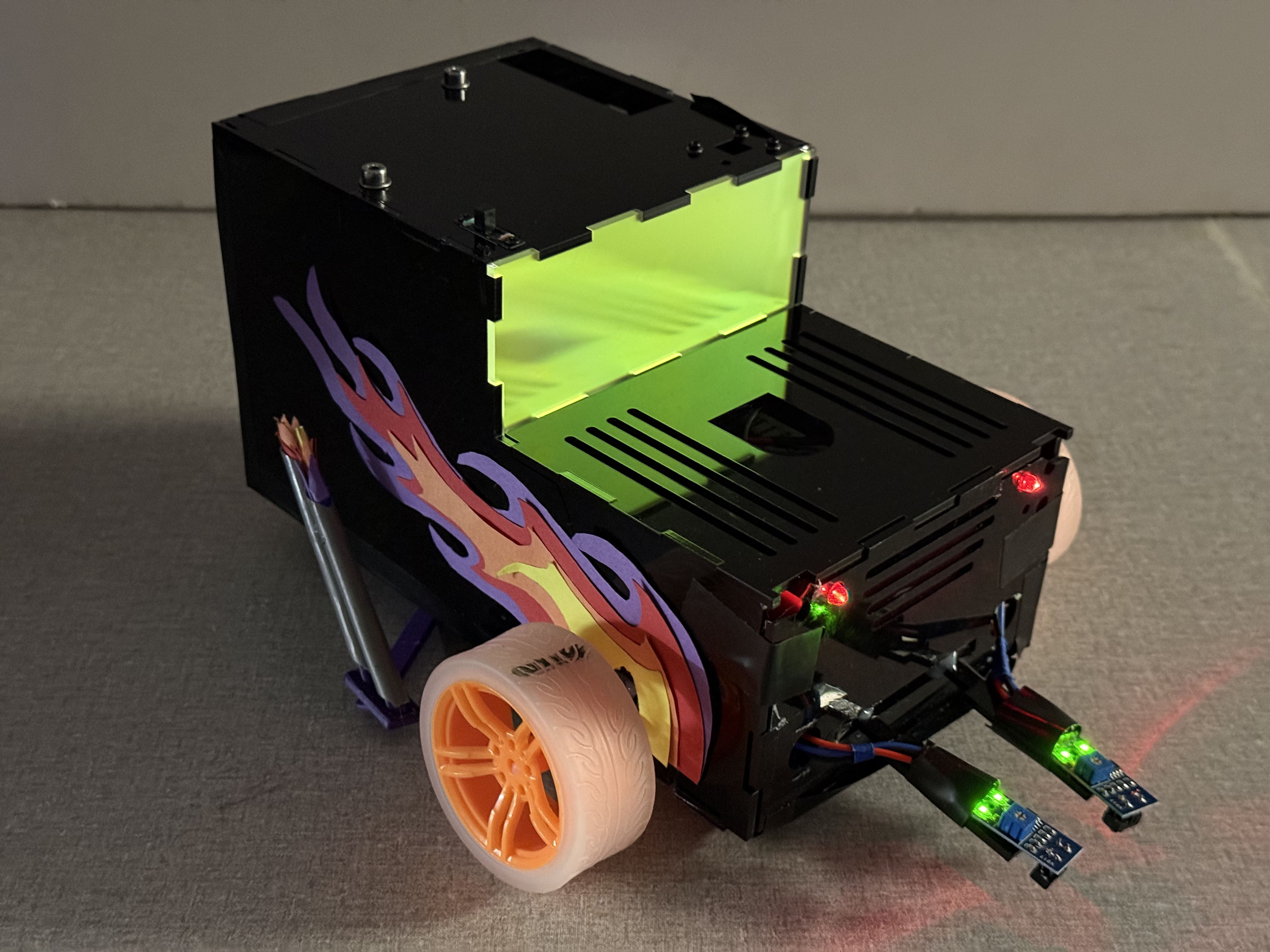
Project Overview
Project Anteater is an autonomous surface cleaning robot designed to navigate and clean a desk surface up to 4ft x 4ft. The robot features an internal power supply, microcontroller-driven operations, and an integrated cleaning system. My role was to lead the team in mechanical design and manufacturing of both the vacuum system and housing.
The Challenge
Design and build an autonomous robot capable of:
- Navigating a 4ft x 4ft desk surface autonomously
- Housing all power systems internally
- Operating via microcontroller for intelligent pathfinding
- Effectively cleaning surfaces with an integrated vacuum system
My Contributions
Vacuum System Design & 3D Printing
Due to the complex geometry required for efficient airflow, I selected 3D printing as the manufacturing method for the vacuum system. By printing in multiple sections, I was able to create:
- Intricate funneling cones optimized for debris collection
- Honeycomb filter structures to prevent debris from entering the vacuum motor
- Multi-part assembly for print reliability and material efficiency
Housing Design & Laser Cutting
I created the complete housing model in SOLIDWORKS, incorporating all electrical components for proper assembly and spacing. With the goal of laser-cutting acrylic sheets, I applied design-for-manufacturability (DFM) principles and exported all parts as DXF files for seamless production. The housing provides:
- Structural integrity and protection for internal components
- Accessibility for maintenance and component access
- Clean, professional appearance
- Optimized layout for weight distribution and balance
Motor-to-Wheel Adapters
I designed and machined motor-to-wheel adapters from 6061 aluminum to efficiently transmit motor rotation into translational movement across the desk. These adapters ensure:
- Precise alignment between motor shaft and wheel
- Reliable torque transmission
- Smooth and responsive movement control
Project Video
Key Skills Demonstrated
3D Printing & Design
Complex geometry optimization, multi-part printing strategy, filter design for airflow efficiency
CAD & DFM
SOLIDWORKS modeling with component integration, design-for-manufacturability principles, DXF export for laser cutting
CNC Machining
6061 aluminum part design, precision machining, motor adapter creation
Team Leadership
Leading mechanical design decisions, coordinating with electrical and software teams, managing manufacturing timeline
Key Takeaways
Project Insights
- 3D printing enables complex geometries that traditional machining cannot easily achieve
- Design-for-manufacturability is critical when using multiple production methods
- Component integration in CAD ensures proper assembly and reduces on-site modifications
- Teamwork across disciplines (mechanical, electrical, software) is essential for successful robotics projects