Project Overview
Worked on the design and development of a complete hybrid rocket propulsion system as part of a four-person engineering team. This project combined mechanical design with advanced electronics and embedded systems. I was responsible for leading the avionics team in developing a flight computer system capable of controlling engine actuation, ignition sequencing, and real-time data logging during test fires.
The Challenge
The team needed to design and validate a hybrid rocket engine that could be reliably tested and operated safely. Key objectives included:
- Design a thermally efficient nozzle using rocket propulsion theory
- Validate structural integrity under extreme pressures and temperatures
- Develop an autonomous flight computer for engine control and data acquisition
- Integrate electronic systems (solenoid valves, ignition, load cell) with embedded firmware
- Achieve consistent, repeatable test fire results
Finite Element Analysis (FEA) Validation
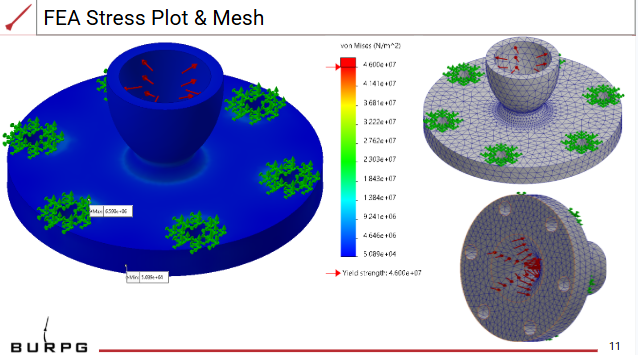
To ensure the nozzle could withstand extreme operating conditions, I performed comprehensive FEA simulations:
- Thermal analysis under combustion chamber conditions (>1500K)
- Stress analysis under peak chamber pressure (350+ psi)
- Combined thermal-stress coupling analysis
- Safety factor verification and design optimization
Results confirmed structural integrity with acceptable safety margins throughout the engine runtime.
Avionics & Flight Computer System
System Architecture & Electronics Design
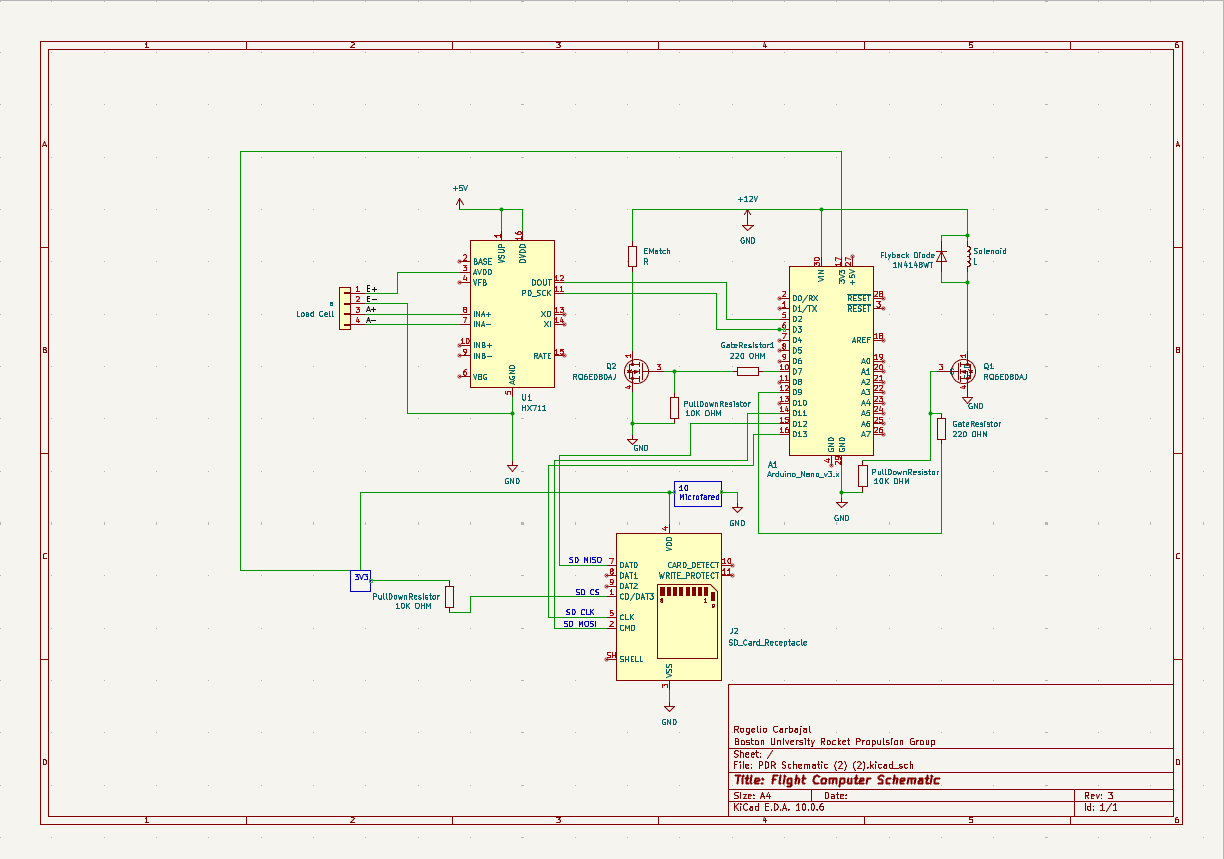
I led the avionics team in designing a complete flight computer system to autonomously control the rocket engine and collect critical test data. The system architecture includes:
- Microcontroller: Arduino Nano for real-time control and data processing
- Solenoid Valve Control: MOSFET driver circuits for fuel oxidizer isolation and flow control
- Ignition System: E-match firing control with safety interlocks
- Load Cell Interface: Precision amplifier circuits for thrust measurement (±5V analog signals)
- Data Logging: SD card module for persistent storage at 1kHz sampling rate
Circuit Design & Schematic
I designed the complete electronic schematic, translating functional requirements into robust hardware:
- Power distribution network with isolated grounds for analog and digital circuits
- High-current MOSFET drivers with gate protection and freewheeling diodes
- Precision instrumentation amplifier for load cell signal conditioning
- Real-time clock (RTC) for precise timing synchronization
All circuits were laid out with proper impedance control, EMI shielding, and thermal management to ensure reliable operation in the harsh rocket environment.
Test Results & Achievements
Successful Hot Fire Test
- Nozzle design validated through FEA with safety factor > 2.5 across all load cases
- Flight computer successfully executed autonomous engine startup and burn sequence
- Load cell data logging confirmed thrust curve matched theoretical predictions within 7% error
- All avionics systems performed flawlessly during 45-second hot fire test
- System recovered with complete telemetry dataset for post-flight analysis
Key Skills Demonstrated
- Rocket propulsion theory and thermodynamic analysis
- Finite element analysis (FEA) for structural and thermal validation
- SOLIDWORKS CAD design
- Analog circuit design and PCB layout (power distribution, signal conditioning)
- Embedded systems programming in C/C++
- Real-time operating system concepts and interrupt handling
- Data acquisition and digital signal processing
- Technical team leadership and cross-functional coordination
- Testing and validation of complex engineering systems